
Where most backyard birds shift between insects, fruit, and seed depending on the season, finches stay remarkably committed to one food source: seed, from the moment they hatch to the end of their lives. This makes them the most straightforward seed specialists in the North American backyard bird world.
The Core Diet: Seed, Almost Exclusively
Grass seed, weed seed, and the seeds of trees like birch, alder, and various conifers make up the overwhelming majority of the diet across all five common backyard species. Bill shape varies by species to match preferred seed type — Pine Siskin’s thin, pointed bill is built for extracting seed from tight conifer cones, while House Finch’s stouter, more conical bill handles larger sunflower seed more efficiently.
Nyjer vs. Sunflower: Two Different Feeding Groups
American Goldfinch, Pine Siskin, and Common Redpoll show a strong preference for tiny nyjer (thistle) seed, while House Finch and Purple Finch favor larger sunflower seed instead. This split is worth planning around directly — see our nyjer seed guide and feeder guide for how to cover both preferences at once.
The Goldfinch Exception: Seed Even for Chicks
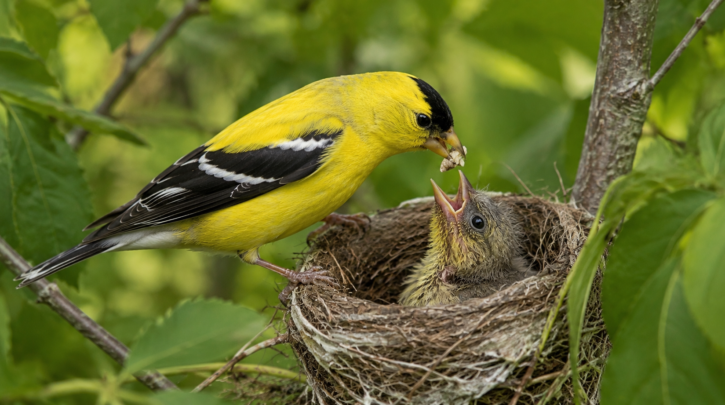
Most seed-eating birds still feed their nestlings insects, since growing chicks generally need more concentrated protein than seed alone provides. American Goldfinch is a genuine exception — it feeds chicks almost entirely regurgitated seed, making it one of the strictest near-total seed specialists among North American songbirds at every life stage, not just as an adult.
Why This Diet Timing Matters
This unusually strict seed diet is part of why American Goldfinch nests so much later than most songbirds — the diet doesn’t require an early-summer insect boom the way most nesting birds do, freeing the species to time its breeding season around seed and down availability instead. See our late-nesting guide for the full explanation.
Wild Food Sources by Species
- House Finch and Purple Finch: a broad mix of weed and grass seed, tree seed, and buds
- American Goldfinch: composite-family seed heads — sunflower, coneflower, thistle, and similar plants — are strongly preferred
- Pine Siskin: conifer seed extracted directly from cones, along with birch and alder seed
- Common Redpoll: birch and alder catkins are a dietary staple across its boreal and Arctic breeding range
Goldfinches are among the strictest seed specialists in North America, feeding their own chicks almost entirely seed at a life stage when most songbirds rely heavily on insects.
Occasional Insect Consumption
Insects aren’t entirely absent from the diet — small amounts are taken opportunistically, particularly by House Finch and Purple Finch — but they make up a genuinely minor share compared to the insect-dependent diets like the bluebird and the woodpecker.
Water Needs
Finches draw some moisture directly from seed, but still benefit from a reliable water source for drinking and bathing, particularly during hot or dry stretches when natural water can be harder to find.
Ready to set up a feeder that actually matches this diet? See our feeder setup guide for nyjer and sunflower feeder designs built around real finch feeding behavior.
Why Standard Birdseed Mixes Underperform
A generic mixed birdseed blend, heavy on milo and cracked corn, does little for finches specifically — most of that filler goes untouched and ends up scattered on the ground. Dedicated nyjer and black oil sunflower consistently outperform generic mixes for actually attracting and holding a finch flock.
How Diet Differs by Season
Even within a largely seed-focused diet, availability shifts noticeably across the year. Spring and summer bring fresh weed and grass seed alongside developing seed heads on garden plants, while fall and winter push birds toward tree seed, cached or standing dried seed heads, and feeder-supplied nyjer and sunflower as natural options become scarcer.
Regional Diet Variation
Diet composition also varies by region depending on which native plants are locally available — a Pine Siskin in a conifer-heavy western forest relies more heavily on cone seed than one wintering in a deciduous eastern woodland, where birch, alder, and weedy field edges make up a larger share of available food instead.
How Bill Shape Reflects Diet Specialization
The conical, seed-cracking bill shared broadly across the finch family shows meaningful variation tuned to each species’ preferred food. Pine Siskin’s finer, more pointed bill excels at working into tight conifer cone scales, while the stouter bills of House Finch and Purple Finch generate more cracking force suited to larger, harder-shelled sunflower seed.
A Diet That Simplifies Feeder Planning
Because the diet is so consistently seed-focused year-round, planning a feeding station for finches is considerably more straightforward than for a species with a diet that shifts dramatically across the seasons — the same core seed types work in spring, summer, fall, and winter alike, with only the relative demand changing as natural food availability rises and falls.