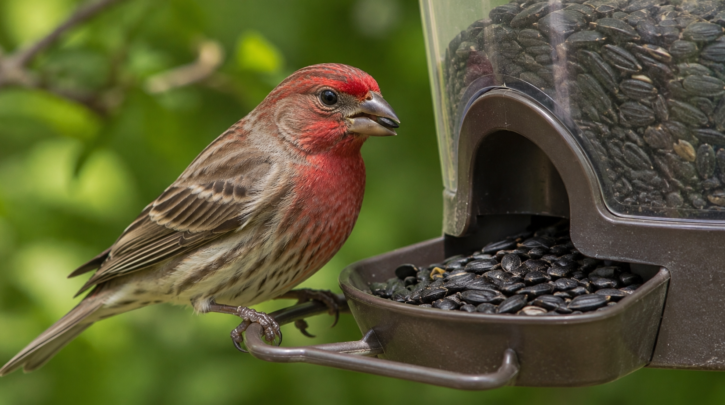

Unlike the specialized tiny ports a nyjer feeder needs, House Finch and Purple Finch feed readily from standard tube and hopper feeders loaded with black oil sunflower seed — the same general feeder style that works well for many other backyard birds.
Why Black Oil Sunflower Specifically
Black oil sunflower is generally preferred over striped sunflower for feeder use, thanks to a thinner shell that’s easier for a finch bill to crack and a higher fat content per seed. See our diet guide for more on why this matters for House Finch and Purple Finch specifically.
Tube Feeders
A standard tube feeder with several feeding ports works well for both species, offering good weather protection and reasonable capacity without needing any of the specialized tiny-port design a nyjer feeder requires. Larger capacity models reduce refill frequency during heavy winter use.
Hopper Feeders
A hopper-style feeder, with a wider feeding tray beneath a seed reservoir, gives House Finch and Purple Finch more room to perch comfortably compared to a narrow tube feeder’s smaller individual ports, and can accommodate slightly larger flocks feeding at once.
Squirrel Resistance
Because sunflower seed is highly appealing to squirrels as well as finches, a feeder with some form of squirrel resistance — a weight-activated closing mechanism, a protective cage, or simple pole placement with a baffle — helps keep seed available for the birds it’s actually intended for.
Material Considerations
Metal-reinforced ports resist the wear of repeated feeding pressure better than plain plastic, extending a feeder’s useful life across multiple seasons of regular House Finch and Purple Finch traffic.
Running Sunflower Alongside Nyjer
A yard hoping to attract the full range of common backyard finches benefits from running a sunflower feeder alongside a dedicated nyjer feeder rather than choosing just one, since House Finch and Purple Finch generally show much less interest in nyjer than the other three species do. See our nyjer feeder guide for that side of the setup.
Whichever feeder style you choose, cleaning matters more here than usual — see our cleaning supplies guide for a routine that actually reduces disease risk.
Feeder Capacity and Refill Frequency
A larger-capacity hopper or tube feeder reduces how often refilling is needed, which matters more during winter when House Finch and Purple Finch activity typically peaks alongside the rest of the feeder-visiting bird community. Smaller feeders work fine for lighter traffic but need more frequent attention during a busy stretch.
Perch Design
A sturdy, appropriately sized perch beneath each feeding port makes a real difference in how comfortably House Finch and Purple Finch can feed, since both species prefer a stable perching position over clinging directly to a port the way a more acrobatic goldfinch or siskin might.
Placement Alongside a Nyjer Station
Positioning a sunflower feeder a reasonable distance from a nyjer feeder, rather than crowding both into the exact same spot, helps reduce competition between the different finch groups each feeder attracts, giving House Finch and Purple Finch their own space separate from the goldfinch and siskin activity concentrated around the nyjer station.
Seasonal Demand
Sunflower feeder activity from House Finch tends to stay fairly consistent year-round given the species’ largely resident lifestyle, while Purple Finch visits shift with its seasonal migration pattern, becoming more noticeable in fall and winter across much of the eastern United States as migrants move south from breeding territory farther north.
A Reasonable Starting Point
For anyone unsure whether to prioritize a nyjer or sunflower feeder first, checking which finch species are actually common locally is a more useful guide than defaulting to one or the other — House Finch is common in most regions, making a sunflower feeder a reasonably safe first investment for most new hosts before adding dedicated nyjer capacity for the other three species a bit later on.
Final Thoughts
A sunflower feeder is one of the lowest-friction ways to start feeding backyard birds generally, and it happens to double as a reliable House Finch and Purple Finch attractant without requiring any specialized equipment beyond what many households already happen to own.
Pairing With the Rest of a Finch Setup
Once a sunflower feeder is established, adding a dedicated nyjer feeder rounds out coverage for goldfinch, siskin, and redpoll, giving a single yard the ability to reasonably attract all five common backyard finch species across the full range of seasons, weather, and irruption conditions each and every year without much additional ongoing effort required from the host once both feeders are properly in place and stocked.