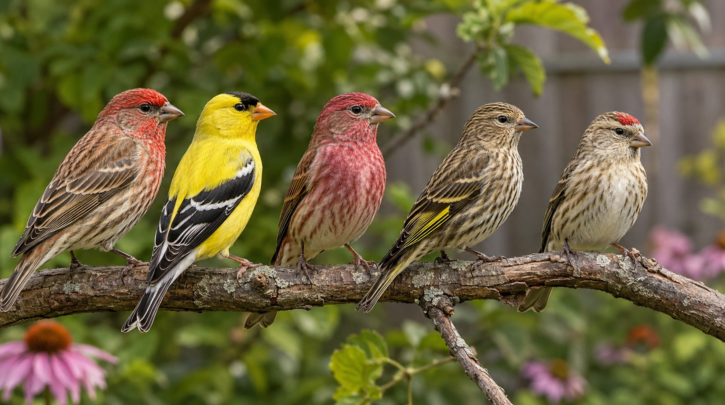

Five finch species make up the overwhelming majority of backyard sightings across North America: House Finch, American Goldfinch, Purple Finch, Pine Siskin, and Common Redpoll. Color and streaking pattern do most of the identification work, but a couple of these species require a closer look than color alone provides.
House Finch
- Male: reddish head, breast, and rump over a brown, heavily streaked back and belly — the exact shade of red varies from pale orange to deep red depending on diet
- Female: plain grayish-brown with heavy streaking overall, no red anywhere
- Bill: short, conical, with a gently curved profile
- Widespread and often the single most common feeder finch across most of the continental US
American Goldfinch
- Breeding male: bright lemon-yellow body, black cap, black wings with white wing bars
- Breeding female: duller yellow-olive, no black cap
- Both sexes molt into a drab olive-brown winter plumage, making winter goldfinches much harder to pick out at a glance than the vivid summer birds
- Bill: small and conical, noticeably pink-orange in breeding season and duskier in winter
Purple Finch
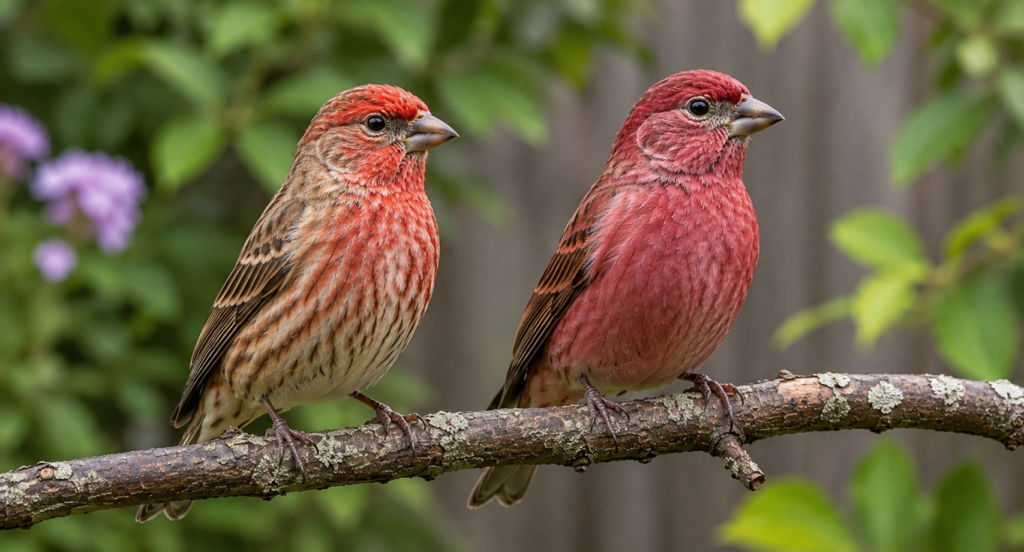
- Male: a deep raspberry-red wash covering the head, breast, back, and rump — more evenly and richly colored than a House Finch, without the heavy belly streaking
- Female: strongly patterned brown and white, with a bold white eyebrow stripe and cheek patch — a much more distinctly marked face than the plain brown House Finch female
- Bill: larger and more conical than House Finch’s, with a notched tail
House Finch vs. Purple Finch: The Belly and Face Test
Males are the trickier comparison: a Purple Finch male’s red is more uniform and less streaky below than a House Finch male’s, and its belly stays largely clean rather than heavily streaked. For females, the face pattern settles it quickly — a Purple Finch female shows a bold, high-contrast facial pattern that a House Finch female’s plain, streaky face simply doesn’t have.
Pine Siskin
- Small, heavily streaked brown finch with a notably thin, sharply pointed bill
- Yellow patches at the base of the wing and tail feathers, most visible in flight
- Sexes look essentially identical — one of the only common backyard birds where this is true across an entire species
- Highly nomadic, appearing in large numbers in some winters and being almost entirely absent in others
Common Redpoll
- Small, streaky brown body with a distinctive small red cap and black chin patch
- Male: additional pink-red wash across the breast
- Female: streaky white breast without the pink wash, otherwise similar to the male
- An irregular winter visitor well south of its Arctic and subarctic breeding range, appearing unpredictably depending on food availability up north
Pine Siskin is the outlier of the group — while every other common backyard finch shows some difference between males and females, siskins of both sexes look essentially identical.
Quick Reference by Bill Shape
Bill shape alone can narrow things down fast: House Finch and Purple Finch both show a fairly substantial conical seed-cracking bill, while Pine Siskin’s bill is noticeably thinner and more pointed, adapted for extracting seeds from conifer cones rather than cracking larger sunflower-type seed.
What to Do Once You’ve Made an ID
Identified a flock working a nyjer feeder? See our feeder guide for what draws each species, and our guide to male vs. female finches if you want to sex individual birds within a mixed flock.
Not sure which species is visiting your yard? Our binoculars buying guide covers the optics that make streaking pattern and bill shape easy to see at typical backyard distances.
Juveniles and Molt Timing
Several of these species show a genuinely confusing juvenile or transitional plumage, particularly American Goldfinch moving between its vivid breeding colors and drab winter plumage twice a year. A goldfinch seen in early spring or late fall may show a patchy mix of both plumages simultaneously rather than a clean transition from one to the other.
Range Overlap
All five species broadly overlap across much of the northern and central United States and southern Canada for at least part of the year, so range alone won’t separate them the way it helps with some other backyard birds. Pine Siskin and Common Redpoll add an extra layer of complexity, since their presence in a given area can vary dramatically from one winter to the next depending on food availability farther north.
Flock Composition Clues
Pine Siskins and American Goldfinches frequently travel and feed together in mixed flocks, so spotting one species at a nyjer feeder is often a good reason to look more carefully through the rest of the flock for the other. Common Redpolls, when present, also readily mix with siskins and goldfinches at a shared feeding station during an irruption year.
Size as a Secondary Clue
All five species are similar in overall size, generally in the five-to-six-inch range, so body size alone won’t reliably separate them the way it does for a more size-varied family like woodpeckers. Bill shape and plumage pattern do almost all of the identification work for this group instead.