
Like most small songbirds, finches face a survival curve weighted heavily toward the first year of life — but one species on this list has a genuinely remarkable physiological adaptation for surviving cold that goes well beyond typical lifespan statistics.
Typical Lifespan by Species
- House Finch: average wild lifespan around two years population-wide, with banding records showing individuals living well past a decade
- American Goldfinch: banding records confirm individuals living past ten years
- Purple Finch: banding records confirm individuals living past eleven years
- Pine Siskin: banding records show a maximum confirmed age around eight years
- Common Redpoll: banding records show a maximum confirmed age around eight years
The First Year Is the Hard Part
As with most small songbirds, a large share of finch mortality happens in the first year of life, driven by predation, starvation, and inexperience finding food and shelter. Birds that survive that first year have meaningfully better odds for every year after.
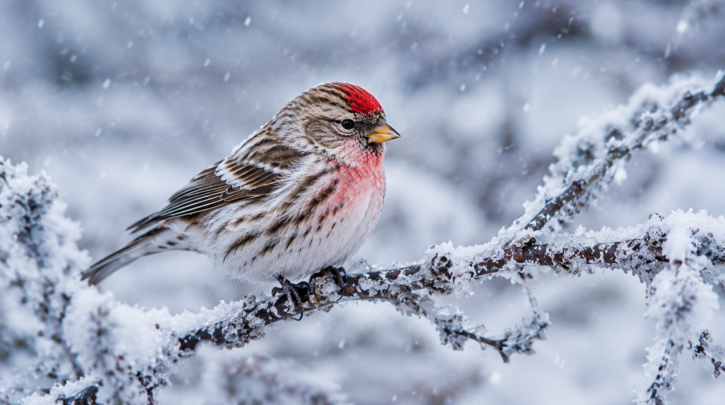
Common Redpoll: A Genuine Cold-Survival Specialist
Common Redpolls breed in the Arctic and subarctic and routinely survive temperatures well below zero Fahrenheit, aided by a specialized adaptation most backyard birds simply don’t have: an expandable pouch in the esophagus that lets a redpoll cache extra seed during the day and digest it slowly overnight, providing a steady source of body heat through the coldest hours without needing to forage in the dark.
Why This Adaptation Matters
This overnight seed-caching ability is a major reason Common Redpolls can survive far colder conditions than most songbirds their size could tolerate, and it’s a genuinely distinctive piece of biology within this group — none of the other four species on this list have an equivalent adaptation, relying instead on more typical winter survival strategies like flocking and reliable feeder access.
How House Finch Eye Disease Affects Population-Level Survival
Beyond individual lifespan, House Finch populations have been meaningfully affected at the regional level by Mycoplasmal conjunctivitis, a bacterial eye disease first documented in the species in the 1990s. See our eye disease guide for what this means for feeder hygiene and why it matters more for this species than for the other four.
What Increases Survival
- A reliable seed source, particularly nyjer and sunflower during lean winter stretches
- Regular feeder cleaning, especially important given House Finch’s documented vulnerability to eye disease transmission at shared feeding surfaces
- Native plants producing seed heads, extending natural food availability beyond what a feeder alone provides
- Water access, particularly during hot, dry stretches or frozen winter conditions
Want to support finches through the toughest stretch of the year? See our nyjer seed guide for what matters most during winter feeding.
How Banding Studies Track Finch Survival
Much of what’s known about finch lifespan comes from bird-banding programs, where researchers fit a uniquely numbered leg band on young or adult birds and track recoveries or re-sightings over subsequent years. Because Pine Siskin and Common Redpoll move so unpredictably between regions, banding data for these two species also helps researchers understand irruption patterns, not just individual lifespan.
Comparing Lifespan Across Bird Species
An adult lifespan in the several-year range, with confirmed records well past a decade for several species, puts finches roughly in line with the other birds once first-year mortality is factored out. What sets Common Redpoll apart isn’t a dramatically longer lifespan but a genuinely unique physiological toolkit for surviving conditions that would kill most similarly sized birds outright.
Why Flocking Behavior Supports Survival
Several of these species, particularly Pine Siskin and Common Redpoll, spend most of the non-breeding year in flocks rather than as isolated individuals, which offers real survival advantages — more eyes watching for predators, and better collective ability to locate unpredictable, patchy food sources like a good conifer seed crop during a winter irruption.
What This Means for a Backyard Host
Because so much of finch survival depends on unpredictable natural seed crops well outside any single yard’s control, a reliable, well-maintained feeding station becomes an especially valuable supplement during winters when the wild seed crop up north has failed and irruptive species are searching further afield than usual for a dependable food source closer to home.
A Family Defined by Adaptability
Across all five species, the common thread in long-term survival isn’t any single adaptation but a general flexibility — willingness to flock, to travel unpredictable distances in search of food, and to rely on backyard feeders as a genuine supplement rather than an occasional bonus, all of which help this family persist through conditions that would be far harder on a less adaptable species.