
Because the five common backyard finch species split fairly cleanly into a nyjer-preferring group and a sunflower-preferring group, a complete finch feeding setup generally means running two different feeder types rather than expecting one design to satisfy every visiting species.
Nyjer Feeders
Built around very small ports that dispense nyjer’s tiny seed a bit at a time without spilling it everywhere, nyjer feeders typically come in two main styles: a rigid tube with small slotted openings, or a mesh sock that birds cling to directly while pulling seed through the fabric.
Mesh Socks vs. Tube Feeders
Mesh socks are inexpensive and can host several birds clinging at once across the whole surface, but they degrade faster and offer less weather protection than a rigid tube. Tube feeders last longer and shield seed from rain more effectively, generally at a higher upfront cost.
The Upside-Down Feeder Trick
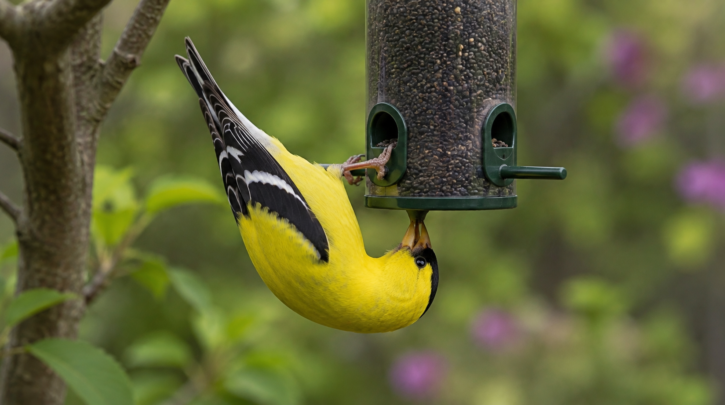
Some nyjer feeders position feeding ports below a perch, or eliminate the perch entirely, requiring a bird to feed while clinging upside down. Goldfinches and siskins are genuinely comfortable feeding this way, while less acrobatic species — including House Sparrows, which compete with finches at a shared feeding station — generally aren’t, making this a clever, passive way to favor the intended finches without any active exclusion effort.
Sunflower Feeders for House Finch and Purple Finch
A standard tube or hopper feeder loaded with black oil sunflower seed works well for both species, without needing the specialized tiny-port design nyjer requires. Black oil sunflower is generally preferred over striped sunflower, thanks to a thinner shell that’s easier to crack and a higher fat content per seed.
Running Both Feeder Types Together
A yard hoping to attract the full range of common backyard finches benefits from offering both a nyjer feeder and a sunflower feeder rather than picking just one, since the two feeding groups genuinely don’t overlap much in seed preference.
Placement Tips
- Position within reasonable distance of shrubby cover, giving finches a quick escape route from a feeder that leaves them fairly exposed
- Keep nyjer feeders somewhat sheltered from heavy rain to slow seed degradation
- Space multiple feeders apart if hosting large winter flocks, to reduce crowding and competition at a single station
Cleaning: More Important Than for Most Feeders
Finch feeders, and nyjer feeders in particular, need regular cleaning — not just for general hygiene but because House Finch is specifically vulnerable to a documented eye disease that spreads at shared, poorly maintained feeding surfaces. See our eye disease guide for why this matters more here than for almost any other backyard bird.
Ready to build a cleaning routine around this risk? See our feeder cleaning supplies guide for what actually gets a feeder properly disinfected between refills.
Feeder Capacity and Flock Size
Winter flocks, particularly during a Pine Siskin or Common Redpoll irruption, can grow considerably larger than the small groups typical of summer, and a feeder with more ports or greater capacity reduces competition and crowding during these unpredictable high-traffic periods. A single small feeder that works fine most of the year can become a bottleneck during an active irruption.
Material and Weather Resistance
Metal-reinforced ports on an otherwise plastic tube feeder resist the wear caused by frequent, repeated feeding pressure better than plain plastic alone, extending a feeder’s useful life across multiple seasons of regular finch traffic.
Combining Feeder Types on One Pole
A multi-arm pole system letting a nyjer feeder and a sunflower feeder hang side by side consolidates a full finch feeding station into one convenient location, simplifying both maintenance and refilling compared to managing separate stands scattered around a yard.
When to Replace Rather Than Repair
A feeder with cracked or degraded ports, particularly on a mesh sock nearing the end of its useful life, is worth replacing outright rather than patching, since a compromised feeding surface is both less effective at controlling seed flow and harder to clean thoroughly — directly relevant to the hygiene concerns covered above.
A Simple Starting Setup
For a first-time host, one nyjer feeder and one small sunflower feeder, both positioned within sight of a window and near reasonable shrub cover, covers the essential preferences of all five common backyard species without requiring a large upfront investment in specialized equipment or an elaborate multi-station setup right from the very start of the season.
Growing Into a Larger Setup
As local flock size and species diversity become clearer over a season or two, expanding into additional feeders, larger capacity, or a dedicated multi-arm pole system is a natural next step rather than something that needs to be planned out fully in advance.