
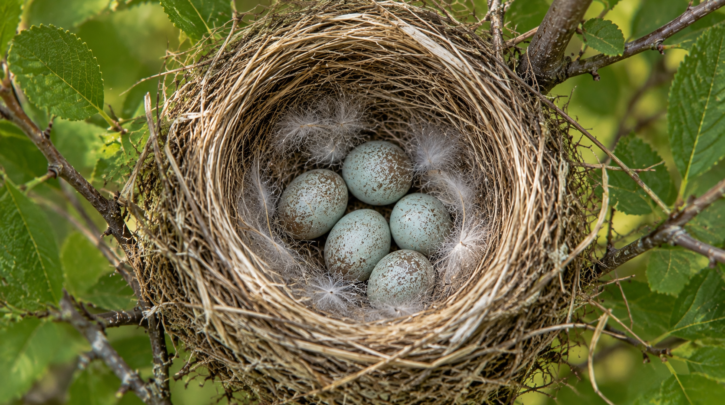

Finch eggs sit in an interesting middle ground compared to other species — lightly marked rather than plain white or heavily scrawled, with clutch size that varies meaningfully by species and, in one case, by the harsh realities of an Arctic breeding season.
Egg Color and Pattern
Finch eggs are typically pale blue or bluish-white with light speckling or fine spotting in brown or darker tones — less heavily marked than an oriole’s scrawled eggs, but not as plain and unmarked as a bluebird’s or woodpecker’s. This lighter speckling still provides some camouflage value in an open cup nest that’s more exposed than a fully enclosed cavity.
Clutch Size by Species
- House Finch: typically 4 to 5 eggs
- American Goldfinch: typically 4 to 6 eggs
- Purple Finch: typically 3 to 5 eggs
- Pine Siskin: typically 3 to 4 eggs
- Common Redpoll: typically 4 to 7 eggs, the largest clutch of the group
Why Common Redpoll Lays More Eggs
A larger clutch size for a species breeding in the Arctic and subarctic makes sense given how compressed and unpredictable a tundra breeding season is — a short window with a real chance of a failed attempt due to weather makes maximizing the number of eggs per attempt a reasonable strategy, compared to species breeding in more temperate, predictable conditions farther south.
Incubation
- Incubation is done by the female alone across all five species
- Duration: roughly 12 to 14 days for most species
- The male typically feeds the incubating female throughout this period rather than sharing incubation duty directly
A Contrast With Woodpeckers
This female-only incubation pattern lines up with the pattern seen in bluebirds and orioles, and stands in direct contrast to woodpeckers, where both sexes incubate and the male specifically takes the overnight shift. Finches follow the more common songbird pattern rather than the woodpecker family’s more unusual shared arrangement.
Timing Relative to Nest Completion
Egg laying typically begins within a few days of a completed nest cup, with one egg added per day until the clutch is complete, and full incubation generally starting once laying finishes — the same general pattern seen across most of the species.
Eggs about to hatch? See our guide to baby finches and fledging for what happens next, including the unusual all-seed diet chicks are fed from day one.
How Finch Eggs Compare Across the Other Species
Finch eggs occupy a genuine middle ground in the spectrum of backyard bird species. Bluebird eggs are plain, unmarked pale blue. Woodpecker eggs are plain white. Oriole eggs are heavily scrawled and blotched. Finch eggs land between the plain and heavily marked extremes, with light speckling that provides modest camouflage value without the dramatic pattern seen in an oriole clutch.
What Egg Appearance Tells You About Nest Type
This intermediate marking level roughly tracks how exposed each nest type is — a fully enclosed woodpecker cavity needs no camouflage at all, an oriole’s exposed hanging pouch benefits from heavy camouflage, and a finch’s open cup, nestled into foliage but still visible from some angles, sits at a reasonable midpoint requiring only modest camouflage.
Monitoring an Active Finch Nest
Because finch nests are open and often placed at a reachable height, especially for House Finch nesting in a hanging planter or similar structure, brief, infrequent visual checks are generally lower-risk than they would be for a more sensitive species, though minimizing disturbance and keeping visits short and calm remains the best practice regardless of species.
What Happens If an Egg Fails to Hatch
As with most songbirds, it’s not unusual for one egg in a clutch to fail to hatch even when the rest of the brood develops normally, particularly in a larger Common Redpoll clutch where an extra egg or two provides some built-in buffer against exactly this kind of individual loss during a short, unforgiving Arctic breeding window.
Egg-Laying Timing Relative to Species Range
Species breeding earlier and farther south, like House Finch across much of its wide range, generally begin egg laying well before a high-latitude breeder like Common Redpoll even arrives on its Arctic breeding grounds, reflecting how dramatically breeding-season length varies across this family depending on how far north or south a given population actually nests.
A Useful Reminder About Regional Variation
Because this family spans such a wide range of breeding latitudes, from suburban House Finch populations in temperate cities to Common Redpoll nesting at the very edge of the Arctic, generalizing timing details across all five species without checking region-specific data can lead to reasonable-sounding but ultimately inaccurate assumptions about when a particular local population is actually likely to be nesting.