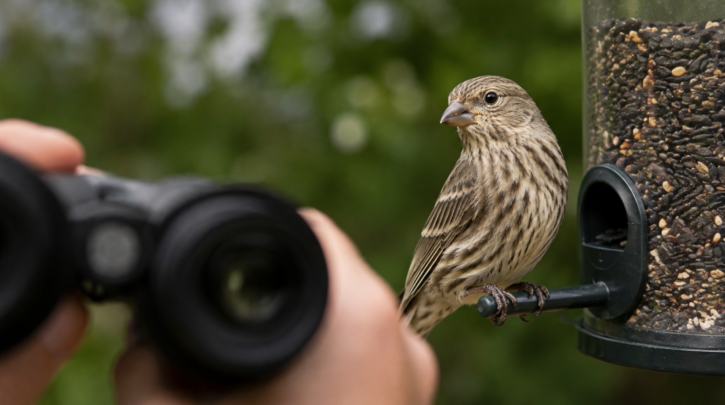

Most binocular advice for backyard birders assumes the hard part is distance — get the bird close enough to see. Finches flip that problem: they’re already at the feeder, ten to fifteen feet away, sitting still. The hard part isn’t distance, it’s telling a female House Finch from a female Purple Finch, or catching the exact streaking pattern that separates a juvenile from an adult. That’s a resolution problem, not a magnification problem, and most binocular shopping advice gets the distinction backwards.
Myth 1: Higher Magnification Always Gets You a Better Look
It feels intuitive: if 8x brings a bird closer, 10x or 12x should bring it closer still, and closer should mean clearer. At typical feeder range, it works the opposite way. Higher magnification narrows field of view, which makes a hopping, head-bobbing finch genuinely harder to keep framed at close range, and it amplifies hand shake exactly when a steady image matters most for judging fine belly streaking or a facial pattern. At 15 feet, 10x binoculars can actually deliver a shakier, harder-to-hold view than a well-built 8x pair — the opposite of what the spec sheet implies.
8x is the practical sweet spot for feeder-distance finch watching specifically: enough magnification to resolve fine detail, wide enough field of view to track a bird that won’t sit perfectly still, and stable enough in hand to actually use that detail once you have it in view.
Myth 2: Since the Bird’s Already Close and Sitting Still, Any Binoculars Will Do
This is close to backwards. Close-range viewing is where cheap glass actually struggles most, not least. Chromatic aberration — color fringing around a bird’s outline — and soft resolution both show up more obviously at short focus distances than they do on a distant silhouette, and short focus distance is exactly what feeder-watching finches offer. The fine color separation between House Finch red and Purple Finch’s deeper raspberry wash, or the subtle streaking that tells a female Purple Finch from a female House Finch as covered in our red finch comparison guide, depends entirely on the kind of color fidelity and sharpness a budget pair often can’t deliver, even at close range where you’d expect any binoculars to perform adequately.
A loud, obvious bird at a distance can tolerate soft glass. A finch at your feeder, where the whole identification hinges on subtle streaking and saturation, can’t.
Myth 3: A Bird at Your Feeder Doesn’t Need a Close-Focus Rating
Close focus distance sounds like a spec built for butterflies and dragonflies, not birds. But plenty of standard birding binoculars can’t focus any closer than 6 to 8 feet — and a finch working a feeder hung outside a kitchen window is frequently well inside that range. Point a pair with a poor close-focus rating at a bird that close, and the binoculars simply can’t lock focus at all, no matter how good the glass is otherwise.
For a species genuinely more likely to be watched at arm’s length than across a field, a close focus distance under 6 feet is one of the few specs worth prioritizing as highly as resolution itself. It’s the difference between binoculars that work for the birding you’ll actually do at a stocked feeder and a pair that only performs well on birds too far away to need this level of detail in the first place.
Myth 4: A Bigger Objective Lens Always Shows More Detail
Objective lens size (the second number in 8×42) governs how much light a pair of binoculars gathers, and bigger generally means brighter — in dim conditions. Most finch watching happens in decent daylight at a feeder, where light isn’t the limiting factor. Jumping from 42mm to 50mm mainly adds weight and bulk without meaningfully improving what actually determines whether you can confirm a streaking pattern: glass quality and resolution, not raw lens diameter. A well-built 8×42 resolves fine detail better than a mediocre 8×50, even though the 50mm number looks like the upgrade on paper.
Myth 5: Premium ED Glass Is Overkill for “Just Backyard Birds” Like Finches
This is the myth that costs the most missed IDs. Extra-low dispersion (ED) glass reduces color fringing and sharpens fine detail, and it’s easy to assume that kind of upgrade is wasted on a bird as common as a feeder finch. In practice, finches are exactly the family where ED glass earns its price: separating House Finch from Purple Finch, or confidently sexing and aging birds using the subtle marks detailed in our male vs. female identification guide, depends on color accuracy and sharpness that budget achromatic glass genuinely struggles to deliver. A boldly patterned, unmistakable bird elsewhere in the yard wouldn’t show the difference nearly as clearly — a female finch’s faint streaking will.
What Actually Matters, in Order
- 8x magnification over 10x or 12x, for stability and field of view at close feeder range
- A close focus distance under 6 feet, since finches are often seen well inside that range
- Genuine resolution and color accuracy (ED glass where the budget allows) over objective lens size
- 42mm objective lenses as the practical standard — enough light-gathering for daytime feeder watching without excess weight
None of this requires premium pricing to get right. A mid-range 8×42 with a genuinely close focus rating and decent glass will resolve the streaking and color detail covered in our species identification guide far more reliably than a higher-magnification pair marketed on its numbers alone. For a broader look at how to weigh these tradeoffs across birding in general, the Cornell Lab’s guide to choosing binoculars is a solid starting point — just keep the close-range, high-resolution priorities above in mind, since feeder-distance finch watching asks something slightly different of a pair of binoculars than most general birding advice assumes.