
Fall is genuinely eventful for this family — American Goldfinch is often still finishing its unusually late nesting season while Purple Finch is arriving from the north, and it’s the moment when the year’s winter finch forecast starts taking shape.
American Goldfinch: Still Nesting Into Early Fall
Some goldfinch pairs are still actively nesting into September, making this species one of the last songbirds still raising chicks when most others have long since finished. See our late-nesting guide for why this timing works out as well as it does.
House Finch: Wrapping Up the Breeding Season
By fall, House Finch has generally finished its multiple-brood breeding season and shifts toward a post-breeding molt, settling back into the steady, non-migratory pattern that defines most of its year.
Purple Finch: Returning South
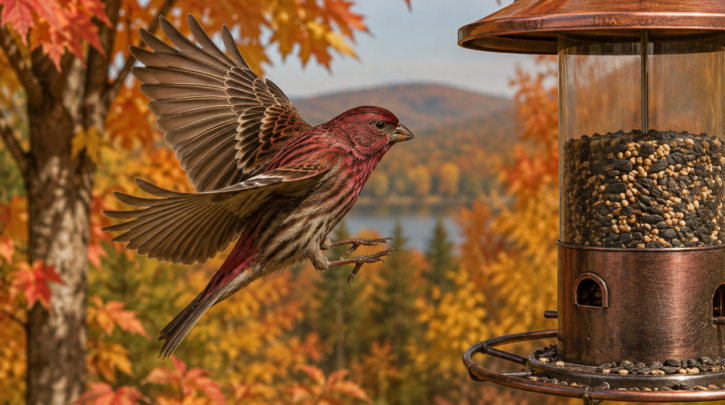
Purple Finch migrates south from its breeding range through fall, becoming a more regular presence at feeders across much of the eastern United States as migrants settle into wintering areas.
Pine Siskin and Common Redpoll: The Irruption Question
Fall is when the annual winter finch forecast, based on surveys of conifer, birch, and alder seed crops across the boreal forest, starts predicting whether these two species are likely to move unusually far south that winter. See our migration guide for the biology behind this forecasting.
Watching for Early Irruption Signs
The first flight calls of Pine Siskins or Common Redpolls moving through in fall are often the earliest on-the-ground sign that an irruption is underway, sometimes arriving before any formal forecast has been widely circulated.
Feeder Activity in Fall
Keep nyjer and sunflower feeders well stocked through fall — goldfinch demand remains high while nesting wraps up, Purple Finch numbers build as migrants arrive, and any developing irruption can bring a sudden surge in siskin or redpoll activity with little advance notice.
Want to know what to expect if an irruption is confirmed? See our winter finch guide for what a genuinely active irruption winter looks like.
A Season of Transition for Every Species
Every one of the five species is doing something different in fall — finishing a nest, molting, migrating in, or waiting to see whether a distant seed crop failure will send it south — making fall one of the more genuinely unpredictable seasons to track across this family.
Preparing Feeders for Uncertain Demand
Because fall demand can shift quickly depending on whether an irruption develops, having a slightly larger feeder capacity in reserve, or being ready to add a second feeder on short notice, helps a feeding station respond to a sudden surge in siskin or redpoll activity without a significant gap in coverage.
Tracking Forecasts and Local Reports
Checking regional birding reports and published winter finch forecasts through fall gives a reasonable early read on what the coming winter might look like, though even a strong forecast can’t predict exact timing or which specific yards will see the heaviest activity within a broader irruption region.
A Good Time for Habitat Assessment
With most nesting activity wrapped up or nearly finished, fall is a reasonable time to assess whether existing native plantings adequately support the seed needs covered in our attracting guide, and to plan any additions for the following spring while the current season’s successes and gaps are still fresh.
Watching Purple Finch Arrive
The first Purple Finch sightings of fall are worth noting carefully against House Finch, given the identification challenge covered in our identification guide — fall is when many hosts first encounter Purple Finch for the season and need to actively work through the bill and facial pattern differences rather than relying on memory from the previous winter.
A Reasonable Fall Checklist
- Check regional winter finch forecasts as they become available
- Watch for the last goldfinch fledglings of an unusually extended nesting season
- Confirm feeders are ready for a potential sudden increase in traffic
- Practice House Finch vs. Purple Finch identification as migrants return
Bridging Into Winter
Whatever fall reveals about the coming winter finch forecast, the practical response stays the same for every host: keep feeders clean, keep them stocked, and stay ready to scale up quickly if an irruption genuinely does end up materializing once the coldest, harshest, and most demanding months of the entire year finally and fully arrive.
A Season That Rewards Attention
More than spring or summer, fall rewards a host who is genuinely paying attention, since the signals that predict a coming irruption winter are subtle and easy to miss for anyone not actively watching feeder activity and regional reports closely.