
Summer is peak activity for most of this family, but American Goldfinch spends much of it conspicuously not nesting — a genuinely unusual pattern worth understanding before assuming something’s wrong.
House Finch: Multiple Broods in Full Swing
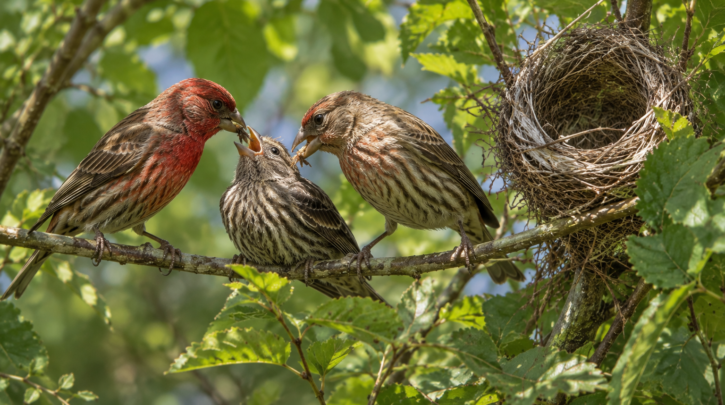
By midsummer, House Finch pairs that started early may already be raising a second or even third brood, taking full advantage of the extended breeding window covered in our baby finches guide.
American Goldfinch: Feeding, Flocking, and Waiting
Through early and midsummer, goldfinches are typically still in loose flocks, feeding on developing seed heads as they mature, rather than nesting. This isn’t a delay or a problem — it’s the normal lead-up to the species’ genuinely late nesting season, timed to coincide with the thistle and milkweed down described in our nest guide.
When Goldfinch Nesting Actually Begins
Most goldfinch pairs don’t start nest building until July, with some waiting into August, meaning a good portion of summer passes before this species even begins the breeding process most other songbirds are already finishing by this point in the year.
Purple Finch: Breeding on Northern Territory
Purple Finch breeding activity is underway across its coniferous and mixed-forest breeding range through summer, generally out of sight of most backyard hosts farther south, who won’t see the species again until it returns as a fall or winter visitor.
Pine Siskin and Common Redpoll: On Northern Breeding Grounds
Both irruptive species spend summer on their boreal and Arctic breeding grounds, essentially absent from most of the backyard range they might have visited over the previous winter. Their return, if it happens at all, won’t begin until fall at the earliest.
Feeder Activity Through Summer
Expect steady House Finch traffic at sunflower feeders throughout summer, with goldfinch feeder visits continuing at a fairly consistent pace even while the species isn’t yet nesting. Purple Finch, Pine Siskin, and Common Redpoll are typically absent from most backyard feeders during this stretch.
Want to know when goldfinch nesting activity actually ramps up? See our late-nesting guide for the full timeline.
A Season of Contrasts
Few families illustrate how differently “summer” can look across related species as clearly as this one — House Finch juggling multiple broods, Goldfinch still weeks from its first, and two entire species absent from the backyard picture altogether until fall.
Watching Seed Heads Develop
Summer is a good time to watch native plants like coneflower and sunflower develop their seed heads, since goldfinches are already visiting these plants opportunistically well before formal nesting begins, feeding on partially developed seed as it becomes available rather than waiting for full maturity.
Water Needs in Summer Heat
Hot summer weather makes a reliable water source more valuable than usual for every species in this family, particularly for House Finch parents making frequent feeding trips to an active brood. A shallow, clean birdbath benefits the whole feeder community during the hottest stretches of the season.
A Quiet Stretch for Some Species
With Purple Finch, Pine Siskin, and Common Redpoll all absent from most backyard ranges during summer, feeder diversity naturally narrows to House Finch and Goldfinch for much of the season — a useful thing to know so a quieter summer feeder doesn’t get mistaken for a sign something has gone wrong.
Monitoring House Finch Broods
With multiple broods potentially overlapping across a single summer, it’s not unusual to see fledged young from an earlier attempt still being fed nearby while a pair works on a new nest for a subsequent brood, a busy, overlapping pattern quite different from the single, unhurried effort most goldfinch pairs are still weeks away from beginning.
A Reasonable Summer Checklist
- Keep sunflower feeders well stocked for continuous House Finch demand
- Watch native seed heads for early goldfinch feeding activity ahead of actual nesting
- Maintain a clean water source through the hottest stretches
- Don’t expect Purple Finch, Pine Siskin, or Common Redpoll activity until fall at the earliest
A Preview of the Fall Ahead
By late summer, the first signs of the coming transition start to appear — goldfinch nesting finally getting underway in earnest, House Finch broods winding down, and the earliest hints, however faint or genuinely uncertain at this early stage, of whether a winter finch irruption might already be quietly building farther north this particular year.
A Season Worth Patience
Summer asks more patience of a finch host than any other season, given how long Goldfinch makes everyone wait before nesting finally begins, but that patience is rewarded once the late-summer nesting push finally gets underway in full.