
Given House Finch’s documented history with Mycoplasmal conjunctivitis, covered in our eye disease guide, genuinely effective feeder hygiene deserves real attention here.
Why a Simple Rinse Isn’t Enough
Rinsing a feeder with plain water removes visible debris but does little against the bacteria and residue that actually drive disease transmission at a shared feeding surface. A proper cleaning routine needs an actual cleaning agent, not just water, followed by a full rinse and complete drying before refilling.
Enzyme-Based Cleaners
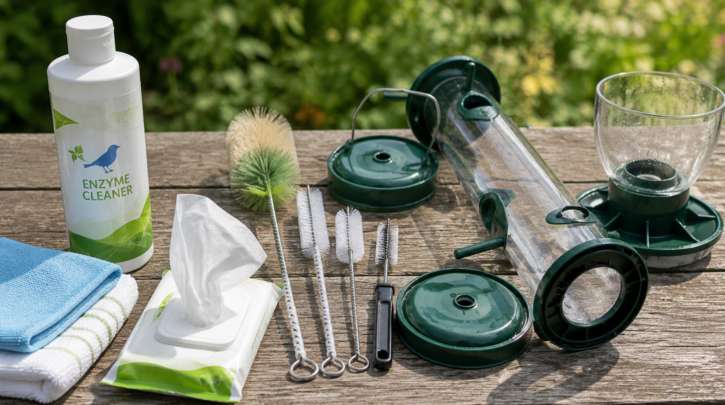
Enzyme-based feeder cleaners, sold specifically for birding use, break down organic residue — dried seed, droppings, biofilm — more thoroughly than water alone, without introducing harsh chemical residue that could be harmful to visiting birds. These are typically diluted into a soaking solution the whole feeder is submerged in before scrubbing.
Cleaning Wipes for Quick Maintenance
Pre-moistened cleaning wipes formulated for feeder use offer a fast option for routine maintenance between full cleanings, useful for wiping down ports and perches without needing to fully disassemble a feeder every single time.
Diluted Bleach as an Alternative
A diluted bleach solution — roughly one part bleach to nine parts water — is a widely recommended, inexpensive disinfecting option, provided the feeder is rinsed extremely thoroughly afterward and allowed to dry completely before any seed goes back in. Any lingering bleach residue is worth avoiding entirely, which is why complete rinsing and drying matter as much as the cleaning step itself.
Cleaning Brushes
A set of brushes sized to reach into narrow tube feeder ports and corners makes a real difference in cleaning thoroughness compared to trying to wipe out a feeder with a cloth alone. Look for brush sets designed specifically for the port sizes on your particular feeders, since a brush too large simply won’t reach the areas that matter most.
A Realistic Cleaning Schedule
- A full cleaning with an actual disinfecting agent every one to two weeks under normal conditions
- More frequent cleaning during wet weather, when mold and bacterial growth accelerate
- Immediate cleaning any time a sick bird is observed at a feeder
- Complete drying before refilling, every time, regardless of which cleaning method is used
Want the full picture on why this matters so much for this particular family? Revisit our eye disease guide for the background behind this recommendation.
Storage and Restocking Cleaning Supplies
Keeping a basic cleaning kit — a bottle of enzyme cleaner, a couple of appropriately sized brushes, and a supply of wipes for quick touch-ups — on hand year-round makes it far more likely that cleaning actually happens on schedule rather than being postponed because supplies ran out at an inconvenient moment.
Cleaning Multiple Feeders at Once
For a yard running both a nyjer feeder and a sunflower feeder, cleaning both on the same schedule, even if one seems less heavily used, keeps the whole feeding station on a consistent hygiene routine rather than letting a less-visited feeder become a lower-priority source of contamination over time.
Signs a Feeder Needs Cleaning Sooner Than Scheduled
- Visible mold or discoloration inside the feeder or on perches
- A noticeably reduced number of visiting birds despite otherwise favorable conditions
- Any sighting of a bird with visibly swollen or crusty eyes at or near the feeder
- Caked, wet, or clumped seed that hasn’t been refreshed recently
A Small Habit With Outsized Impact
Given how directly documented this risk is for House Finch specifically, a consistent cleaning routine is arguably the single most impactful habit a finch host can build, outweighing almost any feeder or seed choice covered in other guides.
Building the Habit Into a Routine
Pairing feeder cleaning with an existing weekly or biweekly household task — a Saturday morning yard check, for instance — makes the habit far more likely to stick over a full season than treating it as a separate, easily forgotten chore that has to be remembered independently on its own schedule every single time.
Final Thoughts
Cleaning supplies are the least exciting purchase, but for finches specifically, they may be the most consequential one, given how directly feeder hygiene ties to a documented, real, and well-studied disease outcome for House Finch specifically across a large share of its introduced eastern range specifically since the disease first appeared there several decades ago now, in the mid-1990s near Washington, D.C., and has been tracked closely ever since.