
No other species has a documented disease outbreak this closely tied to backyard feeding behavior — making feeder hygiene a genuinely more important topic for House Finch hosts than for almost any other backyard bird.
What the Disease Is
Mycoplasmal conjunctivitis is a bacterial eye infection first documented in House Finches in the eastern United States in the mid-1990s. It causes swollen, red, crusty eyes, and in severe cases can lead to partial or complete blindness.
Why It’s So Dangerous
The disease itself is rarely fatal directly, but a blind or partially blind finch struggles to find food and spot approaching predators, and most affected birds ultimately die from starvation or predation rather than the infection itself. This indirect mortality pathway made the disease’s population-level impact considerably worse than the direct symptoms alone would suggest.
Population Impact
After emerging in the Washington, D.C. area, the disease spread rapidly through the introduced eastern House Finch population, contributing to significant regional population declines through the late 1990s and 2000s before numbers partially stabilized as some level of resistance developed within the population over time.
Why House Finch Specifically
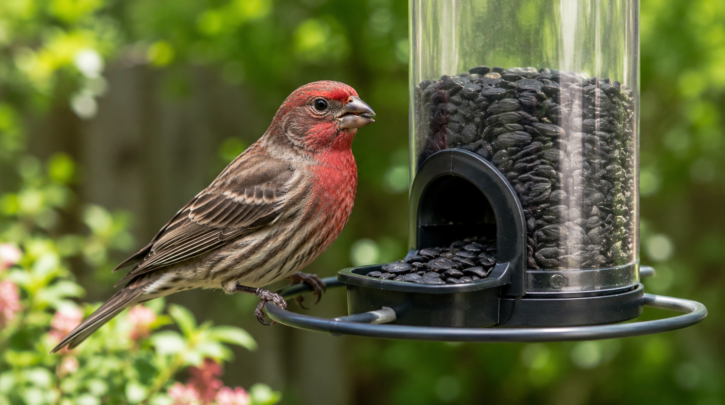
House Finch is overwhelmingly the primary host for this disease, though other species can occasionally be affected. Its highly social, feeder-dependent lifestyle, with birds packed closely together at shared feeding surfaces, likely makes it especially efficient at spreading an eye disease transmitted through direct and indirect contact with contaminated surfaces.
How It Spreads at Feeders
Birds with infected eyes readily contaminate perches, feeding ports, and shared surfaces, which healthy birds then contact directly with their own eyes and faces while feeding. A crowded, poorly cleaned feeder creates close to ideal conditions for transmission between individuals that might otherwise have limited direct contact.
Prevention Through Feeder Hygiene
- Clean feeders regularly with a diluted bleach solution, rinsing thoroughly and allowing complete drying before refilling
- Space multiple feeders apart to reduce crowding and direct contact between birds
- Avoid letting seed and hulls accumulate on the ground beneath a feeder, which can also harbor bacteria
- Temporarily remove a feeder entirely if sick birds are repeatedly observed there, allowing the local flock to disperse before resuming feeding
What to Do If You See a Sick Finch
A finch with visibly swollen, crusty, or red eyes should prompt an immediate, thorough feeder cleaning, and taking the feeder down for a period afterward is a reasonable precaution to reduce further transmission risk to the rest of the local flock.
Ready to build a genuinely effective cleaning routine? See our feeder cleaning supplies guide for what actually disinfects a feeder rather than just rinsing it.
A Lesson for Feeder Hygiene Generally
While House Finch eye disease is the most severe documented example, the underlying lesson applies to feeding any backyard bird: shared feeding surfaces are a genuine disease transmission risk, and regular cleaning is one of the most impactful things a host can do, not just a cosmetic nicety.
How Researchers Track the Disease
Citizen-science reporting programs have played a significant role in monitoring this disease since it first emerged, with backyard observers submitting sightings of affected birds that helped researchers map the disease’s spread across the eastern House Finch population in considerably more detail than professional fieldwork alone could have provided.
Signs of Population Recovery
Some research suggests eastern House Finch populations have developed partial resistance to the disease over the decades since its emergence, contributing to a degree of population recovery from the sharpest declines seen in the late 1990s, though the disease remains present in the population and outbreaks still occur.
Does This Affect Western House Finches Differently?
The disease originated in and initially spread through the introduced eastern population, and some research suggests differences in exposure and impact between eastern and native western House Finch populations, reflecting the different histories and population densities of the two groups since the species’ eastern introduction in the 1940s.
Why This Doesn’t Mean You Should Stop Feeding Finches
The appropriate response to this disease is better hygiene, not abandoning finch feeding altogether — a clean, well-maintained feeder remains a genuinely valuable resource, and the disease risk is meaningfully reduced, not eliminated but substantially lowered, through the straightforward cleaning practices covered above.
A Reminder About Handling Sick Birds
If you encounter a visibly sick finch, avoid handling it directly, since Mycoplasmal conjunctivitis and other pathogens present at a contaminated feeder can pose at least some transmission risk through direct contact. Reporting sightings to a local wildlife agency or citizen-science platform is generally more useful than attempting to intervene directly with an individual bird.