
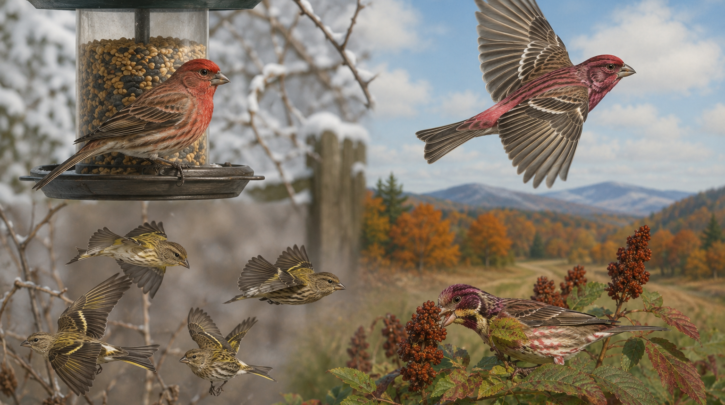

No other bird family shows this much internal variation in migration strategy. Within five species alone, you can find a resident, a partial migrant, a genuine migrant, and two irruptive nomads — all within one family.
House Finch: Largely Resident
Across most of its range, House Finch stays put year-round, similar to the non-migratory pattern of the woodpecker. Some very northern or high-elevation populations may shift short distances seasonally, but the species as a whole doesn’t undertake anything resembling a true migration.
American Goldfinch: Partial Migrant
Goldfinch shows a pattern genuinely similar to the bluebird’s partial migration — northern populations move south for winter, while southern populations remain resident year-round. Which category a given local population falls into depends heavily on latitude.
Purple Finch: A True Migrant
Unlike the more variable goldfinch pattern, Purple Finch undertakes a more consistent short-to-medium distance migration, with most of the breeding population shifting south for winter rather than the population splitting between resident and migratory groups the way goldfinch does.
Pine Siskin and Common Redpoll: Irruptive Migration
Rather than migrating on a predictable annual schedule tied to season or latitude, these two species move nomadically based on food availability — specifically, the success or failure of conifer, birch, and alder seed crops across the boreal forest. In a year with a poor northern seed crop, large numbers move unusually far south; in a year with an abundant crop, they may barely leave their breeding range at all.
Why Irruption Is Genuinely Different From Other Migration
Every other migration pattern follows some predictable cue — season, day length, or a fixed calendar window. Irruptive migration follows none of these; it’s driven entirely by resource availability, which means the same location can see a massive influx of Pine Siskins one winter and none at all the next, with no reliable way to predict which outcome a given year will bring far in advance.
Winter Finch Forecasting
Because irruptions are tied to measurable seed crop conditions, researchers and birding organizations publish annual forecasts predicting which irruptive species are likely to move south in a given winter, based on surveys of cone and seed crop abundance across the boreal forest region. These forecasts are a genuinely useful resource for anyone hoping to anticipate an active irruption winter.
Want to know what an active irruption actually looks like at a feeder? See our winter finch guide for what to expect.
One Family, Every Strategy
This range of strategies within a single family is a useful reminder that migration isn’t one behavior applied uniformly across related species — it’s shaped independently by each species’ specific diet, breeding range, and food reliability, even among close relatives sharing the same general body plan and feeder preferences.
How to Tell Which Pattern You’re Seeing Locally
A finch present at a feeder consistently across every season is most likely a resident House Finch population or a resident-latitude Goldfinch. A finch that’s reliably present in winter but absent in summer, or vice versa, points toward Purple Finch or the migratory end of the Goldfinch range. Genuinely unpredictable year-to-year presence, with a species common one winter and entirely absent the next, is the signature of Pine Siskin or Common Redpoll irruption.
Why This Matters for Feeder Planning
Understanding which pattern applies to a given species changes what a realistic feeding expectation looks like — a host frustrated by inconsistent Pine Siskin visits is likely just experiencing normal irruptive behavior rather than a problem with feeder setup, while consistently absent House Finch activity in a region where the species is common might actually warrant checking the feeder and seed quality.
Migration Distance Compared Across the Family
Even the two migratory species on this list, Goldfinch and Purple Finch, generally travel shorter distances than an obligate long-distance migrant like an oriole — typically a few hundred miles into a milder climate zone rather than a transcontinental or international journey. Irruptive movement in Pine Siskin and Common Redpoll can occasionally cover comparable or even greater distances in an extreme irruption year, despite not following any fixed annual pattern.
What Drives Irruption Timing Within a Single Winter
Irruptive movement doesn’t necessarily happen all at once at the start of winter — birds may continue shifting locations throughout the season as local food supplies are depleted, meaning a quiet start to winter doesn’t rule out a later irruption if conditions change or birds exhaust nearby food sources partway through the season.