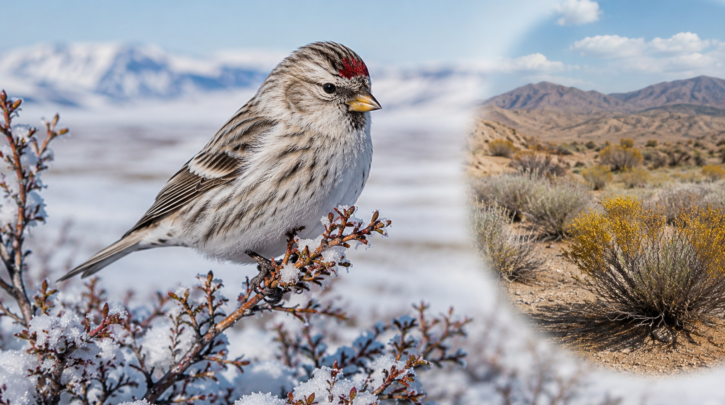

Few backyard bird families span as wide a range of native habitat as finches do — from House Finch’s desert-scrub origins to Common Redpoll’s Arctic tundra breeding grounds, this is a family built around genuine habitat extremes.
House Finch
Originally native to the arid western United States and Mexico, House Finch was introduced to the eastern US in the 1940s and expanded across virtually the entire continent within a few decades. It thrives in open, disturbed, and urban habitat — agricultural land, suburban yards, city parks — more readily than almost any other species on this list.
American Goldfinch
Breeds across southern Canada and most of the United States, favoring weedy fields, floodplains, roadsides, orchards, and suburban yards with abundant composite flowers like sunflower and coneflower. This preference for open, weedy habitat lines up directly with the seed-focused diet covered in our diet guide.
Purple Finch
Breeds in coniferous and mixed forest across Canada, the northern United States, and south through the Appalachians, favoring more wooded habitat than House Finch generally requires. Winters somewhat south of its breeding range into much of the eastern US.
Pine Siskin
Breeds in coniferous and mixed forest across Canada, the northern US, and western mountain ranges. Winter range is genuinely unpredictable, shifting dramatically from year to year depending on conifer seed crop success farther north.
Common Redpoll
Breeds in Arctic tundra and subarctic taiga across a circumpolar range spanning North America and Eurasia, not just this continent. Winters irregularly into southern Canada and the northern US during irruption years, and may not appear at all in a given region for several consecutive winters.
A Family Spanning Nearly Every North American Habitat Type
Taken together, these five species cover an extraordinary habitat range within one family — desert scrub, suburban yards, temperate mixed forest, boreal conifer forest, and Arctic tundra all host at least one common backyard finch species during some part of the year.
Why House Finch Spread So Successfully
House Finch’s rapid range expansion after its 1940s introduction to the eastern US is widely attributed to its genuine flexibility across habitat types, tolerance of human development, and the multiple-brood reproductive strategy covered in our baby finches guide — a combination that let the species establish and grow rapidly across an enormous new range in a relatively short evolutionary timeframe.
Curious which of these species stick around all year and which move seasonally? See our migration guide for the full breakdown.
Overlap Zones
Several species overlap broadly across the northern and central United States for at least part of the year, particularly during winter when Pine Siskin and Common Redpoll may join resident House Finch and Goldfinch populations at the same feeding stations during an active irruption.
Microhabitat Within a Suitable Region
Even within a broadly suitable range, small habitat details shift which species show up most reliably. A yard with abundant weedy edges and standing seed heads favors goldfinch; a yard backing onto conifer forest favors Pine Siskin and, in the right season, Purple Finch; and almost any yard with a feeder and some open ground can attract House Finch, given how little specialized habitat the species genuinely requires.
Elevation Considerations
Purple Finch and Pine Siskin both extend into higher-elevation coniferous forest across much of the western part of their range, while House Finch and American Goldfinch are more consistently found at lower elevations closer to open agricultural and suburban land. Common Redpoll, breeding at extreme northern latitudes, effectively bypasses elevation as a limiting factor entirely, since so much of its breeding range sits at or near sea level despite the harsh climate.
Urban and Suburban Tolerance
House Finch tolerates dense urban environments better than any other species on this list, often thriving in city centers with minimal natural vegetation. American Goldfinch does reasonably well in suburban settings with adequate weedy or garden habitat nearby, while Purple Finch, Pine Siskin, and Common Redpoll generally need more substantial natural habitat within reach to be regular visitors.
A Family Worth Watching Across Regions
Because this family spans such an unusually wide range of habitat types, traveling to a genuinely different region — from suburban lowlands to conifer-forest mountains to the edge of the Arctic — can introduce an entirely different set of finch species than what’s typical at home, making this one of the more rewarding families to encounter while traveling within North America and beyond, given Common Redpoll’s genuinely circumpolar breeding range spanning multiple continents.
Final Thoughts
Range and habitat alone explain a great deal about which of these five species to expect in a given yard, well before diet or feeder choice even enters the picture.