
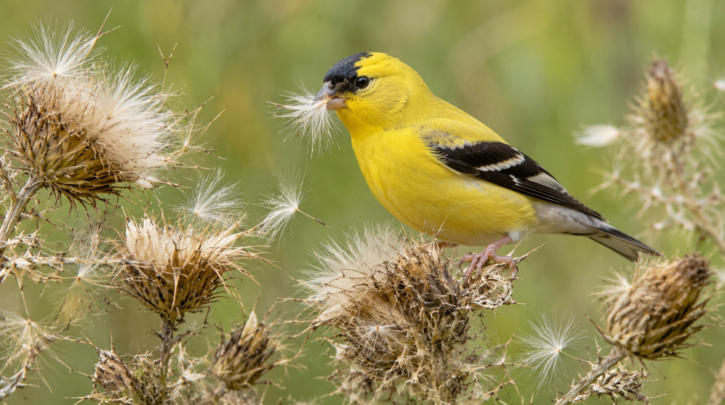

While most North American songbirds are well into raising chicks by June, American Goldfinch is often just getting started — peak nesting runs from July into September, making it one of the latest-nesting songbirds on the entire continent.
The Core Reason: An All-Seed Diet
Most songbirds time nesting around the spring insect boom, since growing chicks typically need the concentrated protein insects provide. American Goldfinch doesn’t follow that pattern — as covered in our diet guide, goldfinches feed chicks almost entirely regurgitated seed rather than insects, which removes the pressure to nest during the early-summer insect peak that shapes most other species’ schedules.
Waiting for Mature Seed Heads
Because chicks are fed seed rather than insects, a goldfinch pair benefits from waiting until seed heads on preferred plants — thistle, sunflower, coneflower, and similar composite flowers — have actually matured, which generally doesn’t happen until mid-to-late summer in most of the species’ range.
The Nest Lining Connection
Seed timing isn’t the only factor. American Goldfinch also relies heavily on thistle and milkweed down to line its tightly woven nest cup, covered in our nest guide, and that down simply isn’t available until the same plants that provide late-summer seed have gone to seed and released their fluffy down as well.
A Compressed but Well-Timed Season
Because both key resources — seed for food and down for lining — become available at roughly the same point in the season, goldfinch nesting timing represents a genuinely well-coordinated strategy rather than simply a delayed or inefficient version of a typical songbird schedule.
How Late Is Too Late?
Some pairs don’t begin nesting until August, and a successful late attempt can still fledge chicks with enough time to prepare for fall before winter sets in, particularly in milder climates. This still leaves considerably less buffer than an early-nesting species has if a first attempt fails and a pair needs to try again.
Usually Single-Brooded as a Result
Given how late the season already starts, most goldfinch pairs raise only one brood per year, unlike House Finch, which commonly manages two or three broods across its earlier-starting, longer effective breeding season. The tradeoff is a single, well-timed attempt rather than several earlier ones.
What This Means for Backyard Hosts
Because goldfinch nesting depends so directly on mature seed heads and down, leaving native seed-producing plants standing through summer — rather than deadheading them for tidiness — directly supports the species’ ability to nest successfully. See our attracting guide for specific plant recommendations.
Curious what the rest of a goldfinch’s year looks like around this unusual timing? See our summer guide for the full seasonal picture.
Comparing Goldfinch Timing to the Other Species
Every other late- or unusually-timed nesting pattern traces back to migration constraints — an oriole compresses its whole nesting cycle into a narrow window bounded by spring arrival and fall departure. Goldfinch’s late timing has nothing to do with migration at all, since the species is only a partial, short-distance migrant at most; it’s driven entirely by diet and nest-material availability instead, a genuinely different underlying cause producing a superficially similar late-season pattern.
Does This Timing Ever Cause Problems?
A late start does leave less buffer if a first nesting attempt fails and a pair needs to try again, and in years with an early, hard fall frost, very late nesting attempts can occasionally run into trouble completing before conditions turn. In most years and most of the species’ range, though, the timing works out reliably enough that it’s clearly a stable, well-established strategy rather than a risky edge case.
A Genuinely Rare Strategy
Very few North American songbirds time their entire breeding season around a specific plant resource the way American Goldfinch does — a nesting calendar built entirely around when certain flowers go to seed, rather than around temperature, day length, or insect availability the way most other songbird nesting schedules are typically set by comparison across North America generally.
A Useful Reminder About Assuming One Songbird Calendar
It’s easy to assume every songbird follows roughly the same spring-nesting, summer-fledging calendar, and American Goldfinch is a genuinely useful corrective to that assumption — a reminder that breeding timing, across the animal kingdom generally, tracks resource availability far more closely than it tracks a fixed calendar date.
Final Thoughts
Goldfinch nesting timing is a small, easily overlooked detail that turns out to explain a great deal about the species — from its late-summer feeder activity to its reliance on standing native seed heads late in the season, all tracing back to this single unusual scheduling choice.