
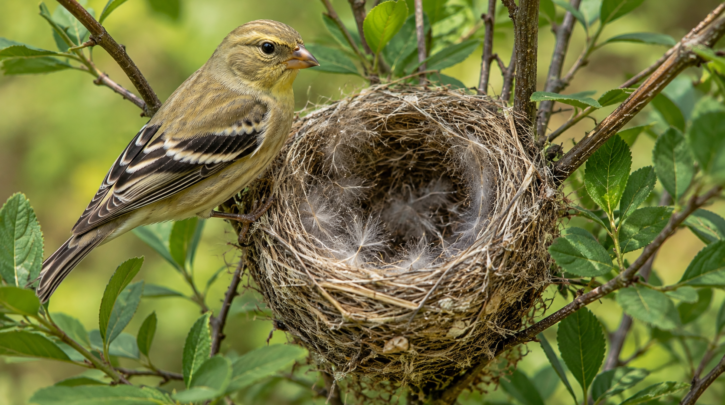

Finches build a straightforward open cup nest — no excavated cavity, no woven hanging pouch — but one species on this list builds a cup so tightly constructed it can genuinely hold water, a detail that sets it apart from almost every other North American songbird nest.
Basic Construction
Across all five species, the female does the great majority of nest building, weaving grass, twigs, rootlets, and plant fiber into a cup shape, then lining the interior with softer material — feathers, plant down, or fine hair — for insulation and comfort. Males may assist by gathering material or feeding the female during construction, but the weaving itself is predominantly her work.
Nest Placement by Species
- House Finch: remarkably adaptable, nesting in shrubs and trees but also readily using hanging planters, wreaths, ledges, and other human-made structures around houses and buildings
- American Goldfinch: placed in shrubs or small trees, typically lower and more open than a Purple Finch or siskin nest site
- Purple Finch: a horizontal branch in coniferous or mixed woodland, generally farther from human structures than House Finch
- Pine Siskin: well out on a conifer branch, sometimes in loosely clustered groups with other siskin pairs nesting nearby — an unusual semi-colonial tendency for a songbird
- Common Redpoll: low in shrubby tundra vegetation, reflecting the lack of tall trees across much of its Arctic and subarctic breeding range
The Goldfinch Nest: Tight Enough to Hold Water
American Goldfinch builds the most finely and tightly woven nest of the group, incorporating spider silk alongside plant fiber to bind the structure so densely that a completed nest can genuinely hold rainwater without leaking through the base. This is a real, well-documented characteristic, not an exaggeration — and it comes with a real risk attached.
A Downside to Waterproof Construction
A nest built tightly enough to hold water can also pose a drowning risk to chicks during a heavy rain event if water pools inside rather than draining away, which is part of why nest placement with at least some overhead canopy cover matters for this species specifically, more than it does for the other four.
Lining Materials Matter
The soft lining inside a finch nest cup does real insulating work, and American Goldfinch in particular relies heavily on thistle and milkweed down for this layer — material that only becomes available once those plants go to seed in mid-to-late summer. This material dependency is a major reason behind the species’ unusually late nesting season, covered in full in our late-nesting guide.
A completed American Goldfinch nest is woven tightly enough with spider silk and plant fiber to hold water — a level of construction precision unmatched by the other four common backyard finches.
How Long Construction Takes
Nest building typically takes a few days to about a week, somewhat faster than the multi-week excavation process of the woodpecker, since there’s no wood to remove — only material to gather and weave.
What Comes Next
Once the cup is complete, egg laying typically follows within days. See our eggs guide for clutch size and incubation, and our baby finches guide for what happens after hatching.
Curious why goldfinches wait so much longer than other songbirds to start nesting? See our full explanation.
Nest Reuse
Finches generally build a fresh nest for each new brood rather than reusing an old one directly, similar to the pattern seen in orioles, though a female may occasionally strip usable material from a previous nest to speed up construction of a new one nearby.
Camouflage and Concealment
Beyond the goldfinch’s distinctive waterproof weave, all five species generally favor placement that blends into surrounding foliage rather than an exposed or highly visible location, using dense leaf cover and the natural coloring of grass and plant fiber to make a completed nest considerably harder to spot than its construction quality alone might suggest.
House Finch’s Unusual Adaptability
House Finch stands out for how readily it accepts artificial nest sites — hanging planters, porch light fixtures, wreaths on a front door, and similar human-made structures all show up regularly in accounts of House Finch nesting. This flexibility is part of why the species has thrived so successfully in suburban and urban environments where natural shrub and tree cover might otherwise be limited.
Comparing Nest Types Across the Bird Families
A finch’s open cup nest sits at yet another point on the spectrum of nest strategies — simpler than an oriole’s engineered hanging pouch, but considerably more effort-intensive than simply occupying an existing cavity the way a bluebird does, and built entirely without the excavation woodpeckers rely on.