
Finches are among the more vocal backyard birds, and several species have calls distinctive enough to identify well before you spot the bird itself — particularly the flight call American Goldfinch gives almost every time it takes off.
House Finch
A long, cheerful, warbling jumble of notes, often rising and falling freely without a clearly fixed pattern, typically ending in a buzzy upslurred or downslurred note. Males sing frequently and at length, often from an exposed perch.
American Goldfinch
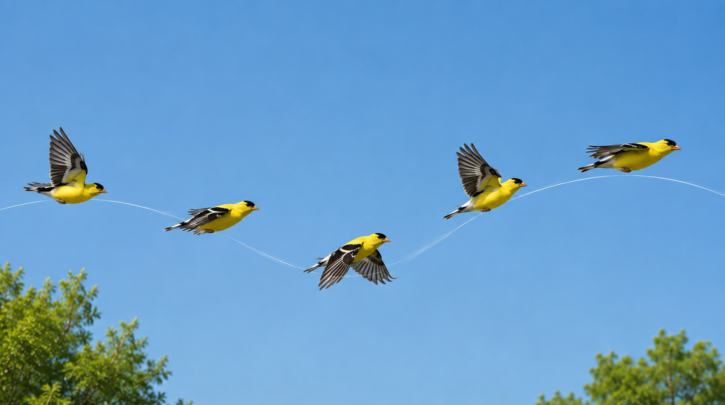
The song is a cheerful, canary-like twittering, but the flight call is the more useful identification tool day to day — a distinctive rhythmic series of notes given during the bird’s characteristic undulating flight pattern, often rendered by birders as sounding like the bird is saying a short, bouncy phrase in time with each dip and rise of its flight.
Purple Finch
A rich, rapid warble, generally more musical and less rambling than a House Finch’s song, often delivered as a continuous, flowing series without the more variable pacing typical of House Finch song.
Pine Siskin
A buzzy, wheezy series of notes that includes a distinctive rising, harsh buzz unlike anything the other four species produce — often the first clue a flock of siskins is moving through an area, since the buzz call carries well and stands out from typical songbird chatter.
Common Redpoll
A series of dry rattles and buzzy trills, generally given in flight or from flocks moving between feeding areas, reflecting the species’ highly social, nomadic lifestyle even outside the breeding season.
Flight Calls Matter More for This Family
Because several of these species — particularly Pine Siskin and Common Redpoll — travel in constantly moving, nomadic flocks rather than holding a fixed territory, flight calls given on the wing are often more useful for day-to-day identification than the less frequently heard territorial song.
Using Sound to Detect an Irruption
In years when Pine Siskins or Common Redpolls move unusually far south, hearing their distinctive flight calls overhead is often the first sign an irruption is underway in a given area, sometimes before any birds have actually landed at a feeder. See our migration guide for what drives this unpredictable movement.
Recognizing Finches by Ear Alone
- A long, loosely structured warbling jumble ending in a buzzy note = House Finch
- A bouncy, rhythmic call given during undulating flight = American Goldfinch
- A rich, continuous, musical warble = Purple Finch
- A harsh, rising buzz = Pine Siskin
- Dry rattles and buzzy trills from a moving flock = Common Redpoll
Hearing an unfamiliar buzzy call at your feeder this winter? Check our winter finch guide — it might be a Pine Siskin or Redpoll irruption in progress.
Regional and Individual Variation
Like most songbirds, individual males within a species show some personal variation in exact song phrasing, and House Finch in particular is known for a genuinely loose, almost improvisatory song structure that can vary noticeably from one individual to the next, more so than the tighter, more consistent song pattern typical of Purple Finch.
Song Timing Through the Year
Singing activity peaks in spring as territories are established, tapering off through the breeding season and becoming much less frequent outside it. Because several of these species are highly social and flock-oriented outside the breeding season, flight and contact calls — rather than full song — dominate the soundscape for most of the year.
Distinguishing Finch Chatter From Other Feeder Birds
A mixed feeder flock can include finches alongside chickadees, sparrows, and other common backyard species, and the higher-pitched, buzzier quality of most finch calls generally stands out from the flatter chip notes typical of sparrows once you’ve had some practice listening for the difference.
Recordings and Apps
For anyone building familiarity with finch vocalizations, birding apps with sound-identification features and online call libraries are useful for comparing the House Finch’s loose warble against the tighter, more musical Purple Finch song before heading outside, and for learning the specific buzzy quality that flags a Pine Siskin in a mixed flock before you’ve spotted the bird itself among the branches.
Why Learning Calls Pays Off With This Family
Because several of these species are highly mobile and genuinely unpredictable in their local presence — especially Pine Siskin and Common Redpoll during irruption years — learning to recognize a flight call overhead can be the difference between noticing an interesting visitor passing through and missing it entirely simply because no one happened to look up at exactly the right passing moment.