
Most bird families follow one consistent sexual dimorphism pattern — overall color saturation, or a specific head marking, applied the same way across every species in the group. Finches break that pattern entirely: each of the five common backyard species handles the male-female difference in its own distinct way.
House Finch: Red vs. Brown
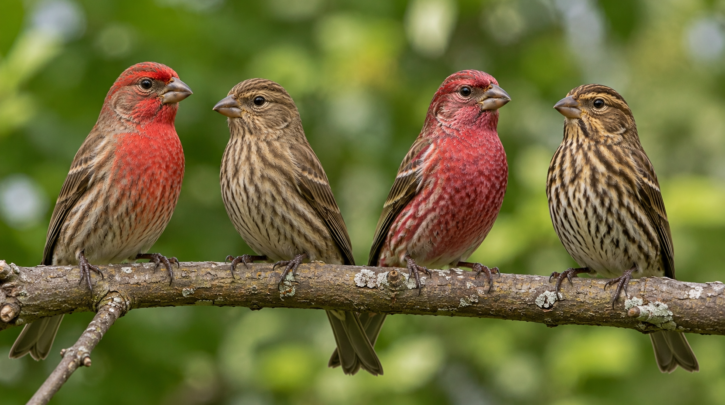
Male House Finches show red on the head, breast, and rump, while females are plain grayish-brown with heavy streaking and no red at all. The intensity of the male’s red is itself variable — more on that in the biology note below.
Purple Finch: Raspberry vs. Bold Facial Pattern
Male Purple Finches carry an even wash of raspberry-red across the head and body. Females aren’t simply a duller version of the male the way a House Finch female is — instead, females show a genuinely distinct field mark of their own: a bold white eyebrow stripe and cheek patch that gives the face much more contrast than a male’s more uniformly colored head.
American Goldfinch: Sexual AND Seasonal Dimorphism
Goldfinches add a second axis most other species don’t have. In breeding season, males are vivid lemon-yellow with a black cap and females are a duller yellow-olive without the cap. But both sexes then molt into a similar drab, olive-brown winter plumage, meaning the male-female difference that’s obvious in summer becomes much subtler — though not gone entirely — once winter plumage sets in.
Pine Siskin: No Reliable Visual Difference
This is the genuine outlier. Male and female Pine Siskins look essentially identical — the same streaky brown body, the same yellow wing and tail patches, with no consistent, field-visible difference between the sexes. Among the five species covered here, and among most common backyard birds generally, this makes Pine Siskin unusual.
Common Redpoll: A Wash of Pink
Male Common Redpolls show a pink-red wash across the breast in addition to the red cap both sexes share. Females have the same red cap and black chin patch but lack the pink breast wash, showing streaky white underneath instead.
Why Finches Don’t Follow One Rule
This variability likely reflects how differently each species’ mating system and habitat have shaped selective pressure on plumage. Species relying more heavily on visual display during courtship, like House Finch and Purple Finch, show stronger, more consistent sexual dimorphism, while a highly social, flocking species like Pine Siskin may simply not benefit as much from visually distinguishing the sexes.
The Diet-Color Connection in Red-Colored Finches
Both House Finch and Purple Finch males get their red coloring from carotenoid pigments obtained directly through diet, not produced internally by the bird’s own body chemistry. A male’s color intensity is a genuinely honest signal of diet quality — birds with access to more carotenoid-rich food during molt show richer, more saturated red, while poorer diet quality can result in a male showing orange or even yellowish tones instead of red.
Curious what each species actually sounds like? See our calls and songs guide for the vocal side of identification.
Molt Timing and the Goldfinch Transition
American Goldfinch is the only one of the five species with a complete molt twice a year rather than the single complete molt (often paired with a smaller partial molt) more typical of songbirds generally. This double molt is what allows such a dramatic seasonal color change, and it means the male-female comparison actually needs to specify which season is being discussed, unlike the other four species where the comparison holds steady year-round.
Field Practice: Sexing a Mixed Winter Flock
Winter flocks mixing House Finch, Pine Siskin, and drab winter-plumage goldfinches can be genuinely challenging to sex at a glance, since two of the three species involved show reduced or absent visual dimorphism during this season. Focusing on head and breast color intensity for House Finch, and simply accepting that Pine Siskins can’t be reliably sexed in the field at all, is the most realistic approach.
Why Purple Finch Females Get Their Own Field Mark
Unlike a House Finch female, which is essentially a plainer version of the male’s underlying pattern, a Purple Finch female’s bold facial stripe is a genuinely distinct field mark in its own right, not simply a duller version of anything the male shows. This makes Purple Finch females, somewhat unusually, sometimes easier to confirm by species than the males, which can occasionally be confused with a richly colored House Finch male at a quick glance.
A Family Without a Single Rule
Taken together, these five species make finches the most inconsistent family for sexual dimorphism — four genuinely different patterns plus one species with no reliable visual difference at all, compared to the single consistent rule that held across every species within the bluebird, oriole, and woodpecker families.